In 1828, a British officer named William Sleeman picked up a small fossil bone near the cantonment at Jabalpur. It was about twenty centimetres long, a single tail vertebra, and nobody at the time knew what it was. Half a century later it turned out to be one of the most consequential dinosaur fossils ever found, because the animal it belonged to would end up giving a whole group of giants its name.
India tends to get left out of the dinosaur story, which is odd, because it has been in it almost from the beginning, and it has some of the best bits.
The bone that named the titans
In 1877 the palaeontologist Richard Lydekker looked at Sleeman's vertebra and a handful of other Indian bones and named the animal Titanosaurus indicus, the "titanic lizard of India." It was the first titanosaur ever described. Titanosaurs went on to become the dominant plant-eaters of the southern continents in the Late Cretaceous, the group that includes the largest land animals that have ever lived, and the entire lot of them, Titanosauria, are named after that one fossil from Madhya Pradesh.
There is a catch. The genus Titanosaurus itself is now treated as a dubious wastebasket, too vaguely defined to be much use, so the original name barely survives on its own animal. The group name stuck anyway.
The people who dug India's dinosaurs out of the ground are half the story. Henry Medlicott, a geologist mapping the Jabalpur beds, turned up a huge upper-arm bone in the early 1870s. Charles Alfred Matley, a British geologist, spent years in the same Lameta rocks and, working with the German palaeontologist Friedrich von Huene, named a clutch of Indian predators in 1933. Matley's name keeps reappearing later, attached to animals he never saw.
Rajasaurus, the crowned predator of the Narmada

The most complete of India's meat-eaters came out of a cement quarry at Rahioli, near Balasinor in Gujarat. A Geological Survey of India geologist, Suresh Srivastava, dug the bones out across two field seasons between 1982 and 1984: a braincase, spine, hip, legs and tail, the first Indian predator known from a decent stretch of skeleton. It then took until 2003 for a team led by Jeffrey Wilson to formally describe it, working alongside the American Institute of Indian Studies and National Geographic.
They called it Rajasaurus narmadensis: raja from the Sanskrit for king or sovereign, and narmadensis for the Narmada river it was found beside. It was a stocky, heavy-built abelisaurid, somewhere between about seven and eleven metres long (23 to 36 feet) depending on which estimate you trust, with a single low horn on top of its head. The horn was made mostly of nasal bone and was almost certainly for display or for head-butting rivals, not a weapon for hunting. Its closest relatives lived in Madagascar and Argentina, a sign that India, even as it drifted, was still sharing its animals with the old southern supercontinent of Gondwana.
Rajasaurus was also the first Indian predatory dinosaur to have its skeleton reconstructed and mounted, so it could be seen more or less whole.
The Jurassic giants of the south
Long before any of that, roughly 185 to 200 million years ago, the river plains of central and southern India held some of the earliest big sauropods known anywhere on Earth.
The star is Barapasaurus tagorei, dug from the Kota rocks of the Pranhita-Godavari valley from 1958 onwards, about three hundred bones from at least six animals. The name is a small delight: bara and pa mean "big leg" in Hindi and Bengali, and tagorei honours the poet Rabindranath Tagore, because the fieldwork happened to fall in the centenary year of his birth. It stood twelve to fourteen metres long (40 to 46 feet) and weighed around seven tonnes, and its mounted skeleton at the Indian Statistical Institute in Kolkata was for years the only mounted dinosaur skeleton in India. It helped bury the old assumption that truly giant sauropods had not yet evolved this early.
It had company. Kotasaurus yamanpalliensis, an even more primitive sauropod, came out of the same kind of rock a little way off in Telangana, around four hundred bones from at least a dozen individuals. Two enormous long-necked plant-eaters, grazing the same Jurassic valley, around a hundred and ninety million years ago.
Titanosaurs, fossil dung, and a name returned
By the end of the Cretaceous, India had drifted north as a giant island and become titanosaur country. The best known of them, Isisaurus colberti, ran to about eighteen metres (59 feet) and fifteen tonnes, but was built oddly for a sauropod: a short, almost vertical neck and unusually long front legs, so it would have stood and moved unlike the familiar long-necked silhouette. Its name is a small tribute to Indian science, after the Indian Statistical Institute that holds it, and to the American palaeontologist Edwin Colbert.
The best thing about Isisaurus is what it ate, and how we know. Fungi preserved in coprolites, which is to say fossil dung, attributed to it are of the kind that infect the leaves of trees. So we can say, from its droppings, that it browsed the foliage of several species of tree, tens of millions of years after the animal itself was gone.
There is also a titanosaur called Jainosaurus, "Jain's lizard," named in 1994 for Sohan Lal Jain, the palaeontologist behind both Barapasaurus and Isisaurus. The man who spent his career naming India's dinosaurs ended up with one named after him.
The giant that crumbled to dust
In 1987 two Geological Survey of India scientists, P. Yadagiri and K. Ayyasami, described some fragments of hip and leg bone from the Kallamedu rocks near Tiruchirapalli in Tamil Nadu. They named the animal Bruhathkayosaurus matleyi, "huge-bodied lizard," with Matley's name once more for the species. If the measurements are right, it may have been one of the largest land animals that has ever existed. A 2023 reassessment put its possible weight at 110 to 170 tonnes and its length near 45 metres (about 148 feet), which would rival or beat the biggest sauropods anyone has ever dug up.
The original bones are gone. By most accounts they crumbled apart before they could be properly studied, and there are accounts of the remains being washed away in a monsoon flood. All that survives is the 1987 description and a few figures and photographs. So Bruhathkayosaurus sits in a strange place: quite possibly the largest dinosaur that ever lived, known only from bones that no one can ever examine again.
A nursery the size of a district
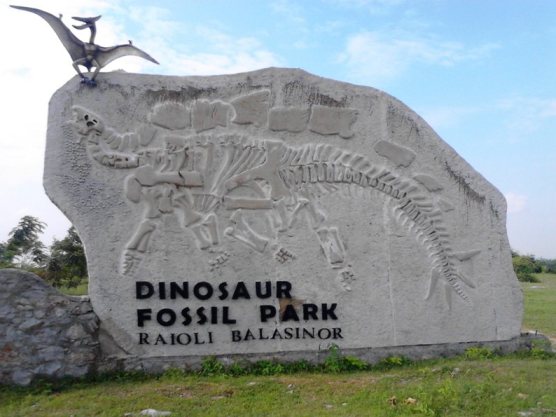
Go back to the Rahioli country around Balasinor, the same ground that gave up Rajasaurus, and you find one of the richest dinosaur nesting sites ever discovered. It surfaced in 1981, when Geological Survey geologists blasting a cement quarry began finding grapefruit-sized stones that turned out to be dinosaur eggs.
The eggs are a type called Megaloolithus, near-spherical and thick-shelled, laid by titanosaurs in clutches on the open floodplain, whole nesting layers of them preserved in the rock. Indian reports often call Balasinor one of the largest dinosaur hatcheries in the world; the more careful sources simply call it the most important dinosaur site in India and leave the league tables alone. Either way the picture is the same. For a very long stretch of time, titanosaurs came back to this ground, season after season, to lay their eggs.
A good deal of that ground survived because of one person. As the site sat neglected for years, Aaliya Sultana Babi, from the former royal family of Balasinor, took it on herself to protect it: shooing grazing cattle off the nests, stopping people from carrying fossils away, and in time turning herself into the site's guardian and its guide. The press calls her the "dinosaur princess," which sounds invented and is not.
The snake in the nest
The single most extraordinary fossil from that nesting country came out of a village called Dholi Dungri. In blocks of rock collected there, palaeontologists found a snake about three and a half metres long, coiled inside a titanosaur nest, wrapped around an egg, right beside a hatchling roughly fifty centimetres long that had just left, or was about to leave, its shell.
A three-and-a-half-metre snake, a titanosaur egg and a newly hatched dinosaur, fossilised together in the moment before a meal, and left in the ground for sixty-seven million years.
The snake, named Sanajeh indicus and described in 2010 by a team led by Jeff Wilson and the Geological Survey's Dhananjay Mohabey, was too primitive to open its jaws wide enough to swallow the eggs whole. So instead it seems to have specialised in the newly hatched young, small and soft as they emerged. Several more snake-in-a-nest blocks from the same area suggest this was not a fluke. It worked the hatcheries.
Buried by their own country

The rocks that hold all these dinosaurs and their eggs, the Lameta beds, sit directly beneath, and in places sandwiched between, the lava flows of the Deccan Traps. The Traps are one of the largest volcanic events in the planet's history: flow upon flow of basalt that buried around five hundred thousand square kilometres of India, erupting across the west and centre of the country right at the close of the Cretaceous. The Western Ghats are its eroded edge.
India's last dinosaurs nested on the floodplains in the gaps between lava flows, and their eggshells turn up in the thin bands of sediment pressed between sheets of basalt.
Then, about sixty-six million years ago, the non-bird dinosaurs vanished everywhere. The asteroid that struck off the coast of Mexico is the headline cause, and deservedly so. But the Deccan Traps were erupting for something like a million years on either side of that impact, loading the air with carbon dioxide, sulphur and mercury, and a great many scientists think they had already been straining the world's ecosystems before the rock from space arrived, a slow poison followed by a sudden blow. How much each one mattered is argued over to this day.
Some of the very last dinosaurs on Earth were Indian, and they laid their eggs between lava flows from the same eruptions that may have helped bring about their extinction.


